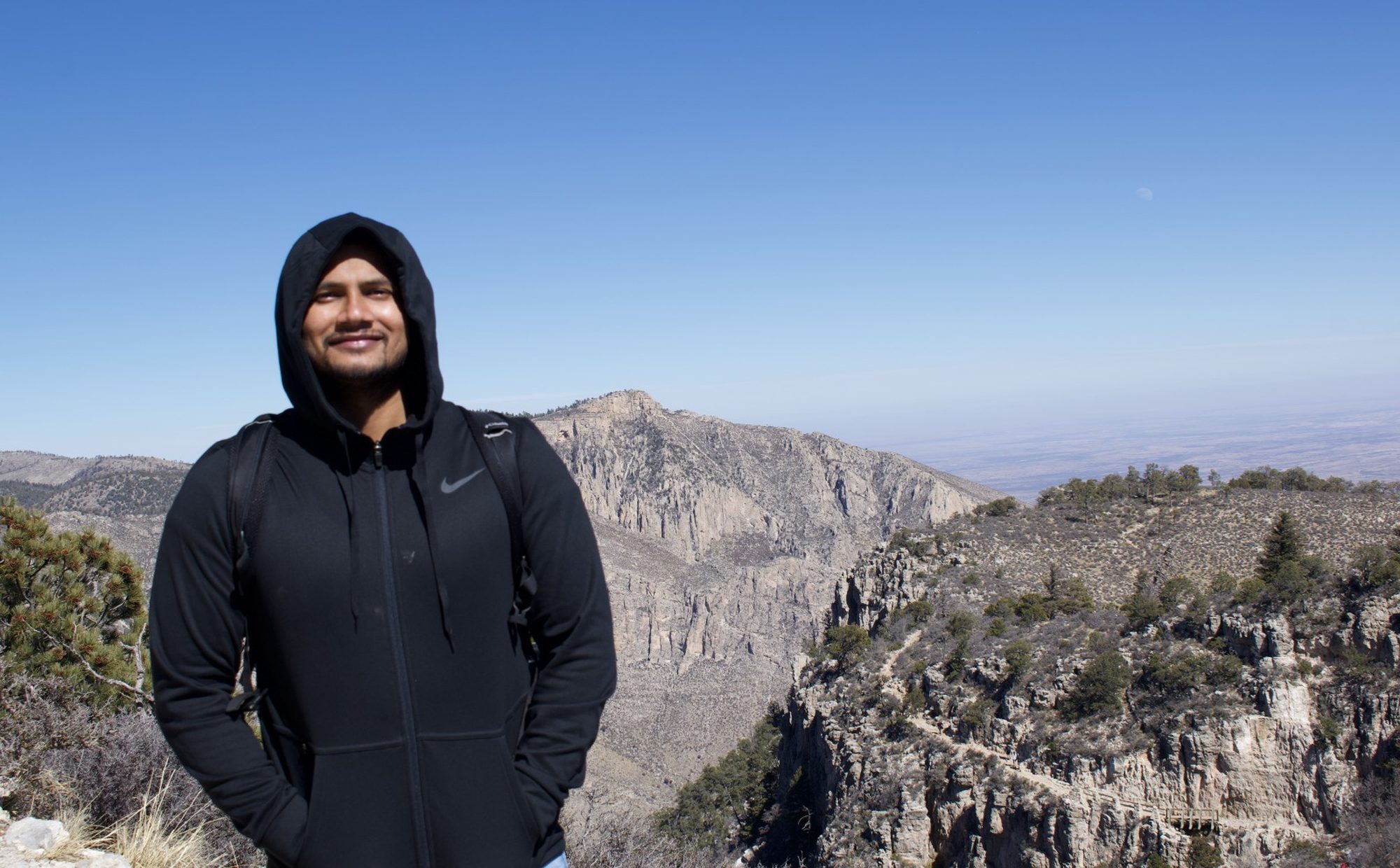

Ganesh Khatei
Penn–TNC Sustainability & Conservation Science Postdoctoral Fellow
Department of Earth and Environmental Science
Vagelos Laboratory for Energy Science and Technology
University of Pennsylvania · Philadelphia, PA
About
I am a Penn–TNC Sustainability and Conservation Science Postdoctoral Fellow in the Department of Earth and Environmental Science at the University of Pennsylvania, a fellowship held jointly with The Nature Conservancy. My research asks how salt moves through soils — and what it does when it gets there. Salinity reshapes soil structure, changes how easily wind lifts dust off the surface, and limits how much of the water in the ground a plant can actually use. I study those processes from the pore scale up to the urban landscape.
At Penn I work on green stormwater infrastructure, urban hydrology, and contaminant transport, testing nature-based approaches to the problem of road salt accumulating in the soils that cities rely on to absorb and clean runoff. Before this I completed my PhD in Geoscience at Temple University with Prof. Sujith Ravi, where I ran wind-tunnel experiments with the USDA Agricultural Research Service to quantify how salinity, sodicity, and atmospheric humidity together control dust emission from salt-affected soils.
I hold an MSc in Geology from the Manipal Academy of Higher Education and a BSc from Ravenshaw University, and I spent three years at the Indian Institute of Science in Bengaluru studying uranium-rich groundwater in semi-arid aquifers. I work across environmental geochemistry, soil physics, and hydrology, and I am always glad to hear from collaborators and from students interested in soils, dust, or urban water.
News
- Began the Penn–TNC Sustainability & Conservation Science Postdoctoral Fellowship at the University of Pennsylvania.
- Completed my PhD in Geoscience at Temple University.
- Presented work on soil salinity, texture, and plant-available water at the GSA Northeastern Section meeting.
- “Biochar reduces road-salt-induced osmotic stress and improves plant water availability in green stormwater infrastructure” published in Water Research.
- Co-authored presentation on salinity-induced shifts in soil water retention at AGU Fall Meeting, New Orleans.
- Paper on the differential effects of salinity and sodicity on aeolian erosion published in Earth Surface Processes and Landforms.
Research
Salt is a quiet but consequential agent in the critical zone. It alters the strength of soil aggregates, the geometry of pore networks, and the energy state of soil water — and each of those changes propagates outward into processes we care about: how much dust a landscape emits, how well a stormwater basin infiltrates, whether a plant can draw water from soil that looks perfectly wet. My work traces those connections experimentally, using wind tunnels, tensiometry, and geochemical and mineralogical analysis to link pore-scale mechanisms to landscape-scale outcomes.
Wind erodibility and dust emissions from salt-affected soils
Salt-affected soils cover a growing share of drylands, yet their dust emission behaviour does not follow the rules developed for ordinary soils. Using USDA-ARS wind-tunnel experiments, I quantified threshold friction velocity, saltation flux, and PM10/PM2.5 emissions across a range of salinity and sodicity treatments, and showed that atmospheric humidity strongly modulates the response. Sodicity and salinity turn out to act through different mechanisms — one degrades aggregate structure, the other cements it — with opposite consequences for particulate emissions (JGR: Atmospheres, 2024; ESPL, 2025).
Road salt, green stormwater infrastructure, and plant water availability
Cities apply road salt every winter, and much of it ends up in the bioretention basins and rain gardens built to manage runoff. I study how accumulated salt raises osmotic stress and reduces the water plants can actually access, and how amendments such as biochar can buffer that effect. This is the core of my Penn–TNC fellowship: evaluating nature-based solutions that keep urban green infrastructure functioning as both hydrologic and ecological assets (Water Research, 2026).
Osmotic–matric coupling in unsaturated porous media
Soil water retention curves are usually treated as a property of texture and structure alone. When salts are present, the osmotic and matric components of water potential interact, and the coupling changes both plant-available water and unsaturated flow. Using HYPROP tensiometry together with van Genuchten, dual-VG, and bimodal retention models, I am working out how to represent this coupling in a way that is useful for predicting behaviour in salt-impacted soils.
Contaminant geochemistry in groundwater systems
Earlier work at the Indian Institute of Science examined uranium- and fluoride-rich aquifers in semi-arid eastern Karnataka: the precipitation–dissolution reactions and carbonate equilibria that mobilise uranium, the mineralogy of the host rocks, and the performance of reverse osmosis units deployed in rural public water supply (Current Science, 2021, 2022). Questions of contaminant fate and water quality continue to run through my current research.
Publications
Full list and citation metrics on Google Scholar.
Peer-reviewed journal articles
- Biochar reduces road-salt-induced osmotic stress and improves plant water availability in green stormwater infrastructure. Water Research, 125598, 2026.
- On the differential effects of salinity and sodicity on aeolian erosion dynamics and particulate emissions. Earth Surface Processes and Landforms, 50(4), e70040, 2025.
- Wind erodibility and particulate matter emissions of salt-affected soils: the case of dry soils in a low humidity atmosphere. Journal of Geophysical Research: Atmospheres, 129(1), e2023JD039576, 2024.
- Reverse osmosis units in groundwater-based public water supply systems in rural eastern Karnataka, India: an analysis. Current Science, 123(12), 1493–1498, 2022.
- High uranium concentration in groundwater used for drinking in parts of eastern Karnataka, India. Current Science, 121(11), 1459–1469, 2021.
In preparation
- Osmotic–matric coupling reduces plant water availability and unsaturated flow in salt-impacted porous media. In preparation, 2026.
Selected conference presentations
- Interactive effects of soil salinity and texture on soil water retention and plant-available water in dryland agroecosystems. 61st Annual Meeting, Geological Society of America, Northeastern Section, January 2026.
- Salinity-induced shifts in soil water retention and plant water availability in arid agricultural soils. AGU Fall Meeting, December 2025. (H41I-1287)
- On the differential effects of salinity and sodicity on particulate emissions from agricultural soils. AGU Fall Meeting, December 2024. (GH53A-2677)
- On the effect of biochar application on the hydraulic properties of salt-affected green stormwater infrastructure. AGU Fall Meeting, December 2024. (H43P-1097)
- Wind erodibility and particulate matter emissions of dry salt-affected soils under diverse atmospheric humidity conditions. AGU Fall Meeting, December 2023. (A53N-2465)
- Compounding effects of salinity and compaction on hydraulic properties of roadside stormwater control measures. EGU General Assembly, Vienna, April 2023.
- Salinity effects on soil surface erodibility and dust emissions. AGU Fall Meeting, 2023.
- Uranium-rich groundwater in some parts of India: geological context. Towards a Sustainable Water Future — Future Earth Conference, Bangalore, 2019.
Teaching & Mentoring
Earth science is at its best when students handle the material — literally. Across four years as a teaching assistant at Temple I developed lab modules and guided students through field, coding, analytical, and quantitative methods, in courses ranging from general-education surveys to graduate seminars. My aim is that students leave able to design a measurement and defend it, not only to recall a result.
- Sedimentary Environments (EES 50940 / 53082) — Temple University
- Process Geomorphology (EES 2097) — Temple University
- Introduction to Geochemistry (EES 2061) — Temple University
- Sustainable Environments (EES 0842) — Temple University
- Geology of the National Parks (EES 0854) — Temple University
Undergraduate research mentoring
I have mentored three undergraduate researchers at Temple in experimental design, sample processing, data analysis, and figure preparation. Each is a co-author on work presented at AGU or EGU.
- Maxwell Finnegan
- Lucy Archibald
- Maya Burke
Methods & Tools
- Instruments
- ICP-MS · ICP-OES · Ion chromatography · SEM · XRD · Laser particle size analyser · HYPROP tensiometry · Microwave digestion · LED fluorimetry · BET · Wind tunnel
- Modelling
- Soil–water retention (van Genuchten, dual-VG, bimodal) · Geochemical modelling · Reactive transport · Groundwater flow
- Computing
- Python · ArcGIS · Google Earth Engine · MATLAB · Origin
- Field & lab
- Soil and water sampling · Mineralogical and petrological analysis · Structural mapping · Electron microprobe analysis
- Languages
- English (fluent) · Hindi (native) · Odia (native) · Kannada (limited)
Awards & Fellowships
- Penn–TNC Sustainability & Conservation Science Postdoctoral Fellowship
- DST INSPIRE Fellowship for PhD
- DST INSPIRE Scholarship
- GATE qualified in Geology and Geophysics
- DST International Travel Grant
Contact
-
khatei@sas.upenn.edu
ganeshkhatei@gmail.com - Office
-
Vagelos Laboratory for Energy Science and Technology (VLEST)
Department of Earth and Environmental Science
University of Pennsylvania
3200 Walnut Street, Philadelphia, PA 19104 - Elsewhere
- Google Scholar · LinkedIn · Penn EES profile · VLEST